Welcome back to the Manhattan Center’s Talk With An Expert blog series!
As we celebrate our monumental 120-year anniversary—dating back to 1906 when Oscar Hammerstein first built this iconic opera house—we’re pulling back the curtain to show you the people who make the magic happen. In this edition, we sit down with Peter Auslan, our Director of Production.
From massive concert rigs and heavy machinery to delicate fashion show lighting and live global broadcasts, Peter and his team ensure every event at the Manhattan Center goes off without a hitch. Let’s dive into what it takes to power the production of one of New York City’s most legendary venues.
Manhattan Center: Briefly, can you describe your role at the Manhattan Center?
Peter Auslan: Safety, Staging, Lighting, Audio, Video, Rigging, Pyrotechnics, Backline, Theatrical Draping, Production Labor, Permitting, Heavy Equipment, Tech Drawings, etc., are all my responsibility.
Manhattan Center: Can you walk us through a “typical” day at The Manhattan Center? (If there is such a thing!)
Peter: There is no such thing, LOL.
Manhattan Center: How did you get your start in the live event and production industry, and what led you to The Manhattan Center?
Peter: I started as a sound engineer in the East Village clubs. As I got better at my job, I got into better clubs and then started to go out on the road with artists. Every artist, every venue, and every crew person I’ve ever encountered has taught me something (sometimes, what not to do).
Manhattan Center: Overseeing production for live concerts, corporate galas, fashion shows, sporting events, and more requires very different skill sets. How do you and your team pivot between these different worlds?
Peter: The equipment is often the same, but the goals are different. It’s all about learning what the expectations are between the different niches. I love designing fashion shows, and yet I know so little about actual fashion.
Manhattan Center: The building dates back to 1906 when Oscar Hammerstein built it as an opera house, and we are celebrating our amazing 120-year anniversary! What are the biggest challenges and rewards of integrating cutting-edge 21st-century production tech into a historic building?
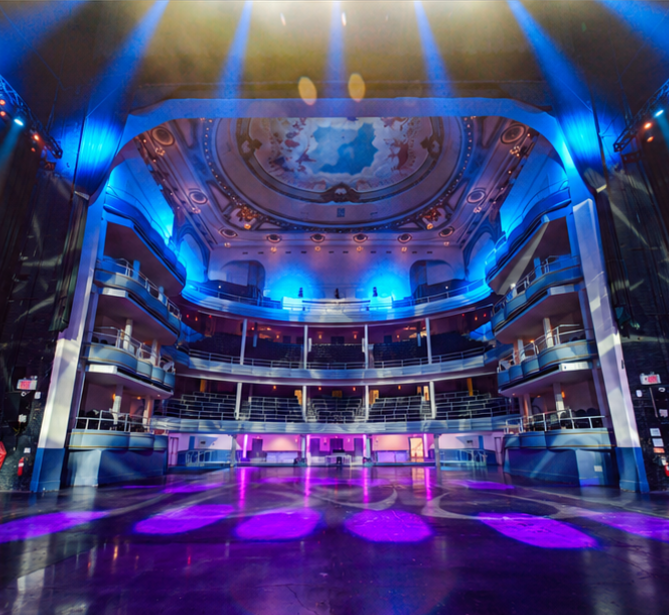
Peter: Older venues can have a nostalgia factor or a type of gravitas that hearkens back to a golden age. Certainly, the Hammerstein has had more than its fair share of historical moments. However, older buildings might not have some of the amenities that newer venues enjoy. In 1906, semi-trucks did not exist, so we have to unload them from the street.
Manhattan Center: When a massive touring act or a major corporate client comes in, what is the one piece of production technology or infrastructure at The Manhattan Center that surprises them the most?
Peter: Our recording and broadcast studios are always a nice surprise for artists. We can have a concert in the Hammerstein and multi-track record from not one, but two separate recording studios, and everything is fiber connected. Add some cameras, and we can live stream it around the world.
Manhattan Center: Without naming names (unless you want to!), what is the most complex or outrageous production request you’ve ever successfully pulled off here?
Peter: Deadmau5 designed a DJ booth that was basically a 13,000lb cube. It was visually stunning, but the condensed weight loads were an issue. We had to bring in a structural engineer to figure out how to safely distribute the weight so it did not wind up leaving a huge hole in the floor. I’m told that they had to pare down the rig for certain other venues because they could not handle the full weight.
Manhattan Center: Live events are unpredictable. Can you share a moment where something went completely wrong behind the scenes, but the audience had no idea, thanks to your team?
Peter: I say this often: there is no such thing as a perfect show. Something will go sideways, a piece of gear fails, some miscommunication, etc. It’s all about the crews paying attention and being able to troubleshoot on the fly. This is where experience matters the most.
Manhattan Center: Where do you see live event production heading in the next 3 to 5 years? Are there any new technologies (like AR/VR, spatial audio, or AI) that you are excited to bring into the venue?
Peter: Technology changes so rapidly and often winds up being employed in ways the original designers did not intend. I don’t have a crystal ball; I just keep my eyes wide open.
Ready to bring your vision to life?
A huge thank you to Peter for giving us a glimpse into the high-stakes, high-reward world of live event production. Whether it’s accommodating a 13,000-pound DJ booth or seamlessly broadcasting an event to the other side of the globe, it’s the quick thinking and unmatched expertise of our crew that keeps the Manhattan Center at the forefront of the industry 120 years later.
To learn more about hosting your next unforgettable event at the Hammerstein Ballroom or the Grand Manhattan, contact our events team today!